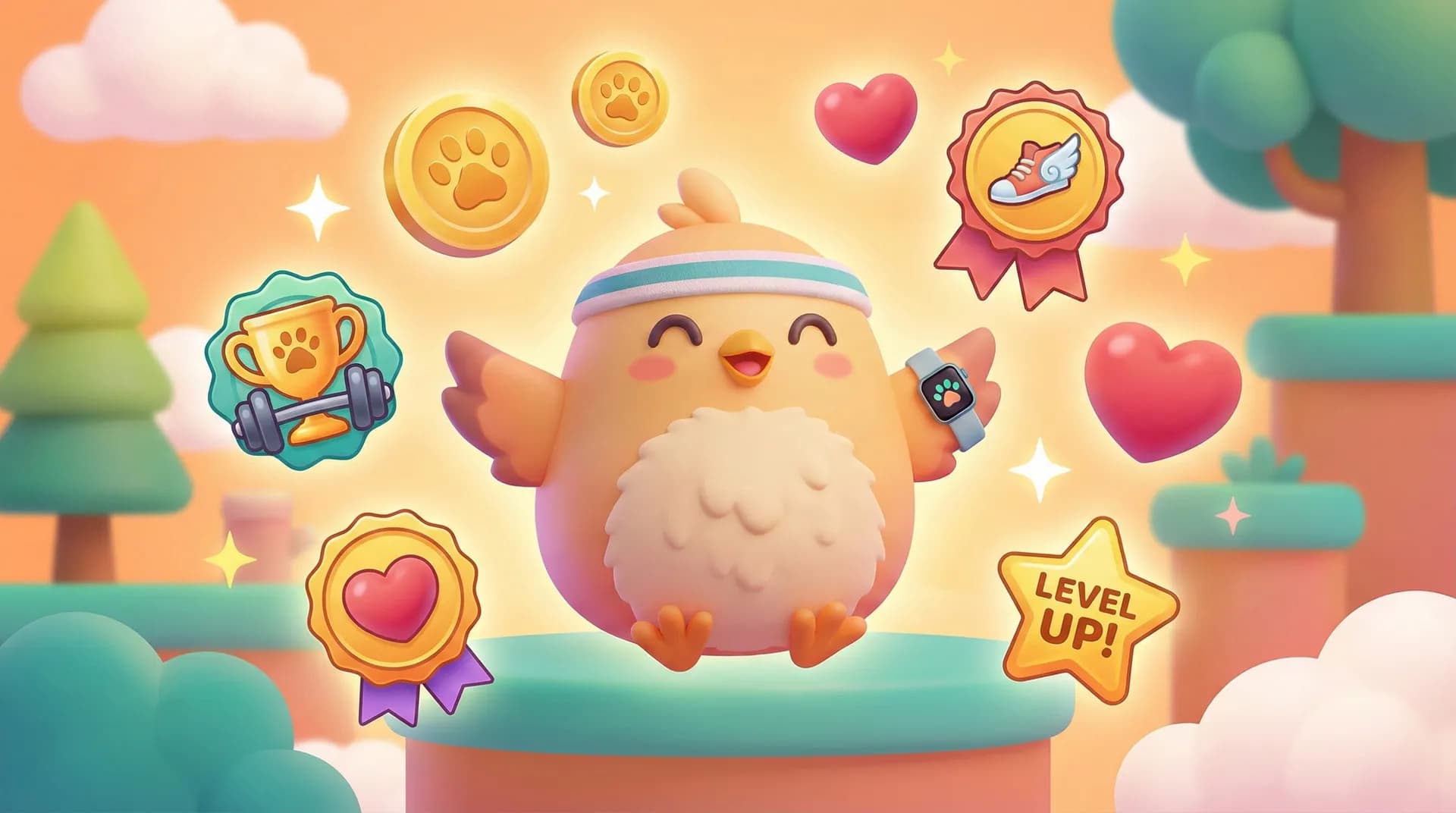
The Science Behind Gamified Fitness Apps (And Why They Actually Work)
Learn why virtual pets, streaks, and rewards keep you exercising when willpower fails. The psychology of gamification reveals the secret to lasting fitness habits.

The Science Behind Gamified Fitness Apps (And Why They Actually Work)
You've tried the New Year's resolution. You've set reminders. You've bought the gym membership and the running shoes. And somewhere around week three, it all falls apart.
Here's the uncomfortable truth: research shows 80% of people give up on their fitness goals by February. By the six-month mark, that number climbs to 95%.
The problem isn't willpower. Willpower is a terrible long-term strategy. It runs out, like a battery that drains faster under stress.
The people who actually stick with fitness have found something better than willpower. They've found ways to make healthy habits feel good right now, not in some distant future when they finally see results.
That's exactly what gamified fitness apps do. And the science behind why they work is fascinating.
Your Brain Doesn't Care About Six-Pack Abs
Let's be honest about how your brain works.
When you decide to exercise, you're making a prediction: "This hard thing now will lead to good things later." Your brain weighs that prediction against easier options, like scrolling social media or eating pizza.
The problem? Your brain heavily discounts future rewards. Behavioral economists call this hyperbolic discounting—we value immediate rewards far more than delayed ones, even when the delayed reward is bigger.
This is why "I'll look great in three months" loses to "This couch is comfortable right now" almost every time.
Your brain processes immediate rewards in the limbic system (emotions) but processes future rewards in the prefrontal cortex (logic). Emotion usually wins.
Traditional fitness apps fail because they only offer future rewards. Charts showing your progress over months. Projections of when you'll hit your goal weight. Statistics that appeal to your logical brain while your emotional brain yawns.
Gamified apps flip this equation. They give your emotional brain something to get excited about today.
How Gamification Hijacks Your Reward System
Games have been engineering motivation for decades. Video game designers know exactly how to keep players engaged for hours. Gamified fitness apps apply those same principles to health.
Here's what's happening in your brain:
1. Dopamine Hits From Variable Rewards
Your brain releases dopamine not when you get a reward, but when you anticipate a reward. And the anticipation is strongest when rewards are unpredictable.
This is why slot machines are addictive. You never know when the next win is coming, so your brain stays engaged.
Gamified apps use this psychology for good. You might earn bonus coins today. You might unlock a rare accessory. You might get a surprise animation. The unpredictability keeps you opening the app.
2. Loss Aversion Creates Accountability
Humans hate losing things more than we enjoy gaining them. Research shows losses feel about twice as powerful as equivalent gains.
Gamified apps leverage this brilliantly. Once you've built a 30-day streak, the fear of losing it becomes powerful motivation. Once your virtual pet is thriving, you don't want to see it get sad.
This creates accountability that statistics can't match. You're not avoiding a missed workout—you're avoiding a loss.
3. Progress Feels Tangible
Traditional apps show progress as numbers: "You've lost 2.3 pounds" or "Your average pace improved by 8%."
Gamified apps show progress as transformation. Your pet evolves. Your character levels up. Your virtual room fills with unlocked decorations. You can see your consistency represented in something meaningful.
This visual progress satisfies your brain in ways that spreadsheets never will.
4. Immediate Feedback Closes the Loop
Every habit follows a loop: Cue → Behavior → Reward.
The reward phase is where most fitness apps fail. A notification saying "Great job!" triggers zero dopamine. There's no emotional payoff.
Gamified apps provide immediate, satisfying rewards. Coins falling on screen. Your pet jumping with joy. A new badge unlocking with a satisfying animation. These close the habit loop properly, making the behavior more likely to repeat.
The Virtual Pet Psychology
Virtual pets deserve special attention because they're particularly effective at creating lasting habits.
When you care for a digital creature that responds to your actions, something interesting happens in your brain. Studies show that emotional bonds with virtual pets activate similar neural pathways as bonds with real pets.
This creates a form of accountability that's hard to ignore. Skipping a workout isn't just failing yourself—it's letting down someone who depends on you.
Why Pipo AI Gets This Right
Pipo AI is a standout example of virtual pet psychology applied to fitness:
Emotional Stakes: Your round bird companion, Pipo, visibly responds to your healthy choices. Complete a workout, and Pipo celebrates. Hit your fasting goal, and Pipo thrives. Miss too many days, and Pipo gets sad (but never punishes you—more on that below).
Sparks and Coins: Every healthy action earns "sparks" that affect Pipo's wellbeing and coins you can spend on customization. This creates multiple reward pathways.
No Punishment, Only Motivation: Unlike apps that guilt-trip you for missed days, Pipo focuses on positive reinforcement. When you return after time away, Pipo is happy to see you. This prevents the shame spiral that causes people to abandon apps entirely.
Customization as Investment: Earning coins to unlock accessories and room decorations creates investment in the system. The more you've built up your Pipo's world, the more you want to maintain it.
The virtual pet approach transforms abstract health goals into something concrete and emotionally meaningful. You're not "exercising"—you're keeping your companion happy.
Types of Gamification That Work
Not all gamification is created equal. Here are the main approaches and when each works:
Competition-Based (Strava, Nike Run Club)
How it works: Leaderboards, challenges, and social comparison push you to perform.
Best for: People who are externally motivated and thrive under competition.
Watch out for: Can create unhealthy comparison or pressure. Works best for people already somewhat consistent.
Collection-Based (Badges, Achievements)
How it works: Unlocking achievements and collecting badges creates a sense of completeness.
Best for: People who love checking things off and seeing progress accumulate.
Watch out for: Loses power once all achievements are unlocked. Needs fresh content to stay engaging.
Streak-Based (Duolingo-style)
How it works: Consecutive day streaks create fear of loss and consistency habits.
Best for: People who are motivated by maintaining momentum.
Watch out for: Can create anxiety around streaks. One missed day can derail motivation entirely.
Nurture-Based (Virtual Pets)
How it works: Caring for a virtual creature creates emotional accountability.
Best for: People who are more motivated by helping others than competing or achieving.
Watch out for: Works only if you actually care about the virtual pet. Not for everyone.
Story-Based (RPG-style progression)
How it works: Your workouts advance a narrative or level up a character.
Best for: People who enjoy games and narrative experiences.
Watch out for: Story needs to be engaging enough to maintain interest long-term.
Building Real Habits With Gamification
Gamification isn't just about short-term tricks. Done right, it actually builds lasting habits. Here's why:
It Lowers Activation Energy
The hardest part of exercise is starting. Getting off the couch. Putting on shoes. Walking out the door.
Gamified apps create a pull that lowers this barrier. You might open the app just to check on your pet, and end up logging a workout because you're already engaged. Traditional apps have no such pull.
It Creates Identity Shifts
The most lasting habits are identity-based. You don't just "do workouts"—you become "someone who works out."
Gamification accelerates this shift. When you've built a 100-day streak, leveled up your character multiple times, or evolved your pet, you start seeing yourself differently. The evidence of your consistency is right there on screen.
It Makes Progress Visible
Most fitness progress is invisible in the short term. You can't see muscle building. You can't see fat cells shrinking. The scale barely moves for weeks.
Gamified apps make every day count visibly. Today's workout equals coins, experience points, or pet happiness. Tomorrow, you have more than yesterday. This visible accumulation sustains motivation during the plateau phases that kill most fitness attempts.
Choosing the Right Gamified App for You
Different gamification styles work for different people. Here's how to choose:
If you show up more for others than yourself:
Choose a virtual pet app like Pipo AI or Finch. The emotional connection creates accountability that self-focused apps can't match. See how Pipo compares in our best fitness apps roundup.
If competition fuels you:
Choose a social competition app like Strava. Leaderboards and challenges against friends will push you to show up.
If you love collecting things:
Look for apps with robust achievement systems and unlockables. The completionist drive can sustain motivation for months.
If you need structure:
Choose apps with quest or program systems that guide you through progressive challenges rather than leaving you to figure things out.
If you're a data person:
You might not need gamification at all. Apps like WHOOP or MyFitnessPal might satisfy your logical brain sufficiently. But consider pairing with a gamified app for the emotional layer.
The Future of Fitness Gamification
This trend is just beginning. Here's what's coming:
AI Personalization: Apps are getting smarter at adapting rewards and challenges to individual psychology. What motivates you specifically will shape your experience.
VR/AR Integration: Imagine fighting virtual monsters with real punches or racing through fantasy landscapes on actual runs. The line between gaming and exercise is blurring.
Deeper Social Integration: Co-op challenges where teams work toward shared goals create community accountability beyond individual competition.
Health Ecosystem Gamification: Sleep, nutrition, mental health, and recovery are all getting gamified. Your virtual pet might soon react to your sleep quality, not just your workouts.
Getting Started Today
Ready to try gamification? Here's how to start:
-
Be honest about what motivates you. Competition? Achievement? Nurturing? Pick an app that matches.
-
Commit to two weeks before judging. Gamification works by building investment over time. Give it a chance to hook you.
-
Tell someone about your progress. Social accountability amplifies gamification effects. Share your pet's growth or your streak with a friend.
-
Don't overthink it. The whole point is that this should feel fun, not like another obligation. If it feels like work, try a different style.
The Bottom Line
Traditional fitness apps treat health like accounting. Track your numbers. Hit your metrics. Stay disciplined.
But humans aren't robots. We're emotional, playful creatures who respond to fun, connection, and meaning.
Gamified fitness apps understand something fundamental: making exercise feel good right now matters more than promising it will feel good someday.
When your workout earns coins, makes your pet happy, or extends your streak, the behavior becomes its own reward. You stop relying on distant goals and distant willpower. The habit sustains itself.
The science is clear. The apps are here. Your virtual companion is waiting.
Pick one. Play for two weeks. See what changes.
You might finally find that the secret to fitness consistency isn't forcing yourself to show up—it's finding an app that makes you want to.
For help choosing the right app, check out our complete guide to the best fitness apps in 2025. And if you're looking to combine gamified fitness with smart nutrition, read how to balance fitness and nutrition.